
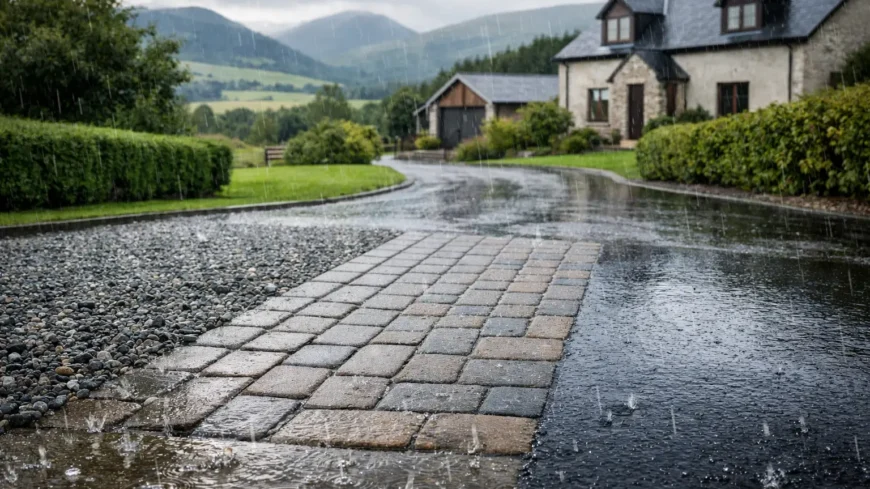
A driveway can look tidy in dry weather and still become a problem the minute heavy rain hits. Standing water, loose material, slippery patches and surface wear usually show up fast once the weather turns. That is why choosing the best driveway surfaces for rain matters so much, especially in Scotland, where regular rainfall can expose weak installation and poor drainage very quickly.
The right surface is not just about appearance. It needs to shed water properly, stay safe underfoot, cope with vehicle traffic and hold up over time without turning into a maintenance headache. For some properties, that means a practical tarmac finish. For others, a permeable system or a carefully laid block surface may be the better fit. The best choice depends on the site, the slope, the ground conditions and how the driveway is used day to day.
What makes a driveway perform well in wet weather?
When people compare driveway materials, they often focus on how the surface looks from the kerb. In wet conditions, performance matters more. A good rain-ready driveway needs to move water away from the surface, resist cracking and rutting, and provide decent grip for both tyres and pedestrians.
Drainage is the biggest factor. Even a durable material can fail if water has nowhere to go. Poor falls, low spots and weak edges allow water to sit, which can shorten the life of the surface and create slip risks. This is why the foundation and drainage design matter just as much as the top layer.
In practical terms, the best driveway surfaces for rain are the ones that combine a suitable material with proper preparation underneath. There is no miracle surface that will compensate for poor workmanship.
Best driveway surfaces for rain: the main options
Tarmac
Tarmac is one of the strongest all-round choices for wet weather. It provides a smooth, durable finish, it is cost-effective for many homeowners and commercial sites, and it performs well when laid correctly with the right gradients and drainage provisions.
One of tarmac’s biggest advantages is reliability. Water runs off it efficiently, and it stands up well to regular traffic. It is also quicker to install than some decorative alternatives, which helps reduce disruption. For busy properties, shared access points and driveways that need to take heavier vehicles, that matters.
The trade-off is that tarmac is not permeable in the same way as loose or open-jointed surfaces. It relies on proper runoff design, channel drains or other drainage measures. If that side of the job is ignored, water will still collect. But where the installation is done properly, tarmac remains one of the most dependable wet-weather options available.
Resin-bound surfacing
Resin-bound driveways are often chosen for their neat appearance, but they also have a practical benefit in rainy conditions. Because the system is porous, water can drain through the surface rather than sitting on top of it. That can help reduce puddling and improve surface performance during prolonged wet spells.
This makes resin-bound surfacing attractive for homeowners who want a more decorative finish without sacrificing drainage. It can also provide a good level of grip when specified correctly.
That said, quality is everything. Resin-bound systems need proper base preparation and a skilled installation team. A poorly installed resin surface can fail early, and not every site is suitable without extra groundwork. It is also usually more expensive than standard tarmac, so it tends to suit customers who place equal value on appearance and performance.
Gravel
Gravel is often seen as a simple answer to drainage because water passes through it naturally. In the right setting, that is true. It can be a cost-effective option and works well on rural or larger properties where a softer, more traditional finish is wanted.
However, gravel comes with compromises. Loose stones can migrate, create uneven patches and make day-to-day use less convenient. In heavy rain, poorly contained gravel can wash out or shift, especially on slopes. It also needs regular upkeep to stay tidy and functional.
For customers who want a low-cost surface and do not mind ongoing maintenance, gravel can still be a reasonable choice. For those looking for a cleaner, more stable finish with less day-to-day attention, it is often not the first recommendation.
Block paving
Block paving can work well in wet weather, but only when it is designed and laid correctly. It offers a smart finish and allows for a lot of visual flexibility, which appeals to homeowners who want kerb appeal as well as practicality.
The key issue with block paving is jointing, base preparation and drainage design. If the sub-base is poor or the falls are wrong, water can sit between blocks, encourage weed growth and lead to movement over time. Permeable block systems can improve drainage performance, but they need to be built as a full system rather than treated as a cosmetic upgrade.
For domestic driveways, block paving can be a strong option where looks matter and the budget allows for proper installation. It is less forgiving than tarmac if corners are cut.
Concrete
Concrete is durable and can last well, but in wet conditions it is not always the best fit for every driveway. Standard concrete is non-porous, so like tarmac it depends on effective runoff. It can also become slippery depending on the finish, and once cracking begins, repairs may be more visible and harder to blend in.
There are situations where concrete makes sense, particularly for hard-wearing utility areas. But for many domestic driveways in rainy parts of the UK, it is often chosen less often than tarmac or resin because of the balance between appearance, drainage and maintenance.
Which surface is usually best?
If the question is which material gives the strongest balance of durability, value and wet-weather performance, tarmac is hard to beat. It suits a wide range of properties, copes well with regular use and delivers consistent results when installed by an experienced contractor.
If drainage through the surface itself is the top priority, resin-bound surfacing may have the edge on the right site. If budget is the main driver, gravel can still be viable, provided the owner accepts the maintenance that comes with it. If visual finish is a major factor, block paving can work very well, but only if the groundwork and drainage are taken seriously.
That is the honest answer – it depends on the property. The best material on paper is not always the best material for a steep drive, a shaded area, poor ground conditions or a site that takes frequent heavy vehicles.
Why installation matters more than many people realise
A lot of driveway problems blamed on the surface are actually caused by what sits underneath it. Weak sub-bases, rushed preparation and poor edge restraint are some of the most common reasons driveways start failing early.
In rainy conditions, those mistakes show up even faster. Water finds low spots, penetrates weak areas and gradually undermines the surface. That is why any worthwhile driveway installation should start with a proper assessment of drainage, use levels and ground condition rather than a quick price based only on square metreage.
For homeowners and site managers, this is where choosing an experienced contractor matters. A dependable installer will explain what is suitable for the site, what drainage measures are required and where spending a little more upfront avoids bigger repair costs later.
What should property owners in Scotland think about?
Scotland’s weather puts extra pressure on driveways. Frequent rain, colder temperatures and seasonal freeze-thaw cycles can all shorten the life of a poorly laid surface. That makes practical material choice even more important.
For many homes and commercial properties across Edinburgh, East Lothian and wider Scotland, a properly laid tarmac driveway remains the safest recommendation because it offers strength, straightforward maintenance and reliable wet-weather performance. Where appearance and permeability are high priorities, resin-bound systems may also be worth considering. The right answer comes from the site survey, not from guessing based on photographs online.
Roadsafe Surfacing Ltd works with customers who need that practical advice from the start, whether the job is a domestic driveway or a larger access area that has to stay safe and serviceable in all weather.
How to make the right decision
Start with how the driveway is actually used. A family home with two cars has different needs from a forecourt, shared access road or commercial yard. Then consider slope, drainage options, appearance, maintenance expectations and budget.
If you want the most dependable all-round option, tarmac is usually the front-runner. If you want a decorative permeable finish and are happy with a higher upfront cost, resin-bound may be the better fit. If you want the lowest initial spend and can accept regular upkeep, gravel may still do the job.
The important thing is not to choose on appearance alone. In wet weather, performance always tells the real story. A driveway should stay safe, drain properly and last – not just look good on the day it is laid.
If you are planning a new driveway or replacing one that struggles every time it rains, the best next step is to get the site assessed properly. A surface that suits your property from the ground up will save money, reduce future repairs and give you one less thing to worry about when the weather turns.