
A car park can have a sound surface and still cause daily frustration if drivers cannot immediately see where to go, stop or walk. The best car park line markings do more than make a site look tidy. They control vehicle movement, protect pedestrians, make better use of available bays and give visitors confidence from the moment they arrive.
For a business, development or public-access site, poorly planned white lining can mean wasted spaces, blocked access routes and avoidable safety risks. The right marking scheme should suit the way your site actually operates, from customer turnover and delivery movements to accessible parking and winter maintenance.
What makes the best car park line markings?
The best marking is not necessarily the brightest line on day one. It is a layout that remains clear under regular traffic, rain, dirt and tyre wear, while making each part of the car park easy to understand. Drivers should not need to guess where bays begin, whether an area is for loading, or which direction traffic should travel.
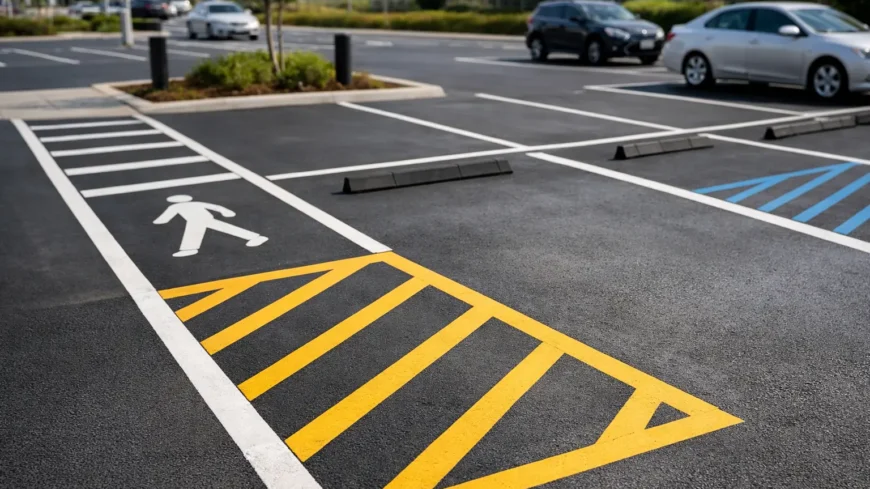
A practical scheme usually combines marked parking bays with directional arrows, pedestrian crossings, give-way markings and hatched exclusion zones where needed. At smaller sites, a simple and well-spaced bay layout may be enough. Larger premises often need a more considered plan to separate visitors, staff, deliveries and pedestrians.
Clear markings also support the appearance of the property. Faded, uneven or poorly positioned lines can make even a recently surfaced car park look neglected. Crisp white lining provides a finished, professionally managed impression that matters to customers, tenants and visitors.
Start with how the car park is used
Before choosing paint, colours or bay sizes, consider the vehicle and pedestrian movements through the site. A retail car park has different demands from a factory yard, medical practice, office development or school. One layout rarely works for every purpose.
Think about peak times, not just quiet periods. Where do vehicles queue? Can larger vans or lorries turn without cutting across parking bays? Are pedestrians walking from vehicles to a building entrance through moving traffic? These questions often reveal where arrows, walkways, stop lines or cross-hatching will make the biggest difference.
Entry and exit points need particular attention. One-way systems can reduce congestion and conflicting movements, but only when arrows and give-way instructions are visible enough to follow in poor weather and low light. If a route is too narrow or the signs and lines contradict each other, drivers will quickly ignore the intended system.
Bay spacing and orientation matter
Bay dimensions and angles should give users enough room to park safely without sacrificing the overall capacity of the site. Straight 90-degree bays can work well where there is sufficient aisle width. Angled bays can encourage a smoother one-way flow and may be easier for drivers to enter and leave, especially in busy car parks.
There is always a trade-off. Maximising the number of bays may look attractive on a plan, but tight spaces lead to door damage, poor parking and blocked aisles. A well-designed car park feels easier to use, which can reduce complaints and improve turnover.
Essential markings for a safe, usable layout
White bay lines are the foundation, but they are only one part of an effective scheme. The markings required depend on the site, although several are consistently useful for commercial and public-facing locations.
Directional arrows should lead vehicles clearly from the entrance through the parking area and towards the exit. Give-way and stop lines help control junctions within larger sites. Pedestrian crossings and designated walkways provide an obvious route from bays to entrances, particularly where families, older visitors or staff on foot may be present.
Hatched markings are valuable where vehicles must not stop or park. They can keep turning heads, fire access points, doorways, bin-store access and visibility splays clear. This is often a small addition that prevents repeated operational problems.
Accessible bays need careful positioning near the entrance and should be marked clearly, with enough surrounding space for safe access. Parent-and-child bays, electric vehicle charging bays, motorcycle spaces and loading areas can also be included where they serve a genuine need. Adding specialist bays without considering demand can reduce useful general parking, so the balance should be reviewed before work begins.
Choosing materials that cope with Scottish conditions
The material used for car park white lining affects visibility, durability and the timing of future maintenance. Standard road-marking paint can be a cost-effective option for lower-traffic areas or fresh surfaces where a clean finish is required quickly. However, heavy-use entrances, turning points and delivery routes may wear faster and need more frequent renewal.
Thermoplastic markings are often chosen for high-traffic locations because they provide a hard-wearing, highly visible finish. They can be particularly suitable for arrows, pedestrian crossings and lines exposed to constant vehicle movement. The right choice depends on the existing surface, expected traffic levels, programme requirements and budget.
Surface preparation is just as important as the product itself. Markings applied over loose material, contaminated areas, standing water or a failing surface will not perform as intended. Oil staining, potholes, cracking and poor drainage should be dealt with first. Otherwise, new lines may look smart initially but deteriorate prematurely as the surface beneath them moves or breaks down.
At Roadsafe Surfacing Ltd, we approach lining as part of the wider condition of the site. Where repairs, resurfacing or drainage improvements are needed, completing those works before final white lining gives the car park a better chance of lasting well.
Colour, contrast and visibility
White remains the standard colour for most parking bays and traffic instructions because it offers strong contrast against dark tarmac. Yellow is commonly used to show restrictions or areas where stopping and parking are not permitted. Blue is often associated with accessible parking, while other colours may be used to identify electric vehicle bays or dedicated areas.
Colour should support the layout rather than complicate it. Too many colours, symbols and messages can make a car park harder to read. A clear hierarchy works best: standard bays are obvious, restricted areas stand out, and pedestrian routes remain easy to follow.
Visibility is not only about colour. Line width, sharp edges and sensible positioning all affect how quickly drivers understand a marking. In Scotland, where rain, low winter light and surface spray are regular considerations, a faded or thin line can disappear far sooner than expected. Quality materials and proper application help retain the contrast that keeps the layout working.
When should car park markings be renewed?
There is no fixed timetable because wear depends on traffic, weather, drainage and the type of marking used. A lightly used private car park may retain a good finish for years. A busy forecourt, supermarket access or industrial yard may show wear much sooner, particularly around entrances, junctions and turning areas.
Renew markings when drivers are beginning to park outside bays, arrows are difficult to read, hatchings no longer keep areas clear, or the site has been resurfaced or reconfigured. Waiting until all lines have disappeared can create a period of unnecessary risk and makes the work more disruptive to organise.
A regular inspection is the sensible approach. Walk the site after rain, at darker times of day and during busy periods if possible. You will see more clearly whether lines are doing their job than from an empty car park on a bright afternoon.
Plan the work to minimise disruption
Car park lining is usually straightforward, but access and timing need to be managed properly. The contractor should understand where vehicles need to enter, whether emergency access must remain open, and how long areas need to stay clear while markings are applied and cured.
For active business premises, works can often be phased by section or arranged outside peak operating hours. Clear temporary barriers and advance communication help prevent vehicles entering freshly marked areas. If the site has had pothole repairs or resurfacing, allowing the surface to reach the appropriate condition before lining is essential for a durable result.
The best car park line markings are the ones users barely have to think about. They guide every movement clearly, protect the spaces that must stay clear and continue to look professional after the first week of traffic. A site survey and a practical layout plan are the right place to start, especially where safety, capacity and daily access all need to work together.