
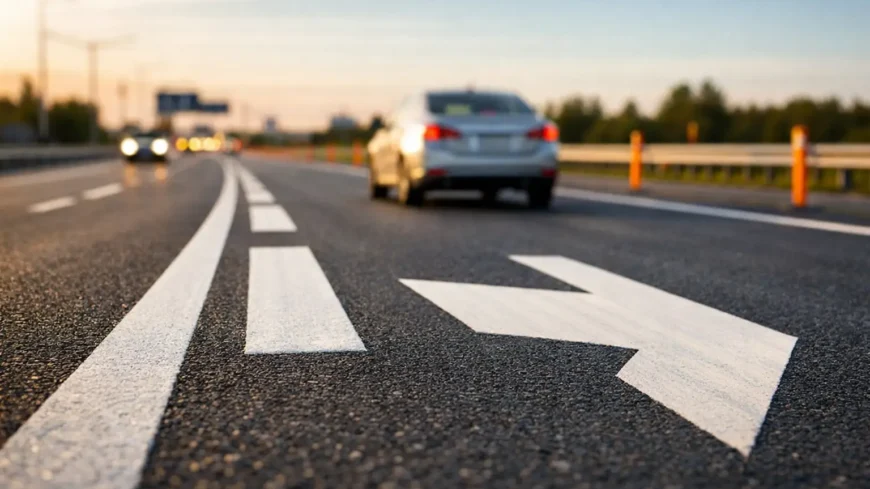
A car park with faded bays and half-visible arrows causes problems long before anyone reports an accident. Drivers hesitate, pedestrians cut across unclear routes, delivery vehicles stop where they should not, and the whole site starts to feel harder to use than it should. That is why understanding the top road marking safety benefits matters for homeowners, businesses, facilities managers and public sector buyers alike.
Road markings are often treated as a finishing touch. In reality, they are part of the surface’s safety system. When they are planned properly and applied clearly, they help people move through a space with less confusion, less risk and far better control.
Why top road marking safety benefits matter on real sites
Good white lining does not just make a site look organised. It gives users instructions at the exact point they need them. A painted stop line, directional arrow, pedestrian crossing or clearly marked bay reduces guesswork, and less guesswork usually means fewer mistakes.
That matters in busy commercial settings where there are cars, vans, lorries and foot traffic sharing the same space. It also matters on private developments, schools, industrial yards and residential areas where users may not know the layout well. If a driver has to pause and work out where to go, the site is already less safe than it should be.
Markings are especially valuable where traffic changes through the day. A forecourt in the morning, a delivery yard in the afternoon and a car park during weekend peak hours all place different pressures on the same surface. Clear line marking helps the site keep working properly even when use becomes heavier or more unpredictable.
Clearer guidance means fewer driver errors
The most immediate safety benefit is simple – people can see what they are expected to do. Lane markings, give way lines, arrows and hatchings create order quickly and without constant supervision.
When markings are sharp and correctly positioned, drivers make decisions earlier. They choose the right lane sooner, slow down in the right place and avoid cutting across areas meant for pedestrians or loading activity. That helps reduce sudden braking, awkward reversing and side-swipe incidents, which are common on poorly marked sites.
This is one of the top road marking safety benefits because it improves behaviour without relying on signs alone. Signs can be missed. Instructions on the ground are harder to ignore because they sit directly in the driver’s line of travel.
There is a practical point here too. If your site already has an awkward layout, line markings can improve safety significantly, but they cannot fully fix bad design. Sometimes the safest result comes from combining fresh markings with changes to traffic flow, bay sizes or access points.
Pedestrian safety improves when routes are obvious
Pedestrian safety is often where line marking has the biggest visible impact. People naturally take the shortest route, especially in car parks, retail areas, schools and public access spaces. If there is no clear crossing point or walkway, they will create one themselves.
Marked pedestrian routes, zebra-style crossings, buffer zones and no-parking areas help separate vehicles from foot traffic. That separation lowers the chance of near misses and makes the site easier to use for children, older people and anyone carrying bags, pushing trolleys or managing limited mobility.
For employers and property owners, this is not just about general good practice. It is about reducing exposure to avoidable incidents. A safer route from entrance to building, or from parking area to reception, is a small detail that can make a major difference.
Visibility matters here. In poor weather, low winter light or heavy site use, a clean and well-maintained pedestrian marking stands out far better than a faded one. In Scotland, where weather conditions can change quickly, that reliability is especially important.
Better traffic flow reduces conflict points
Most accidents on private sites do not happen at speed. They happen because vehicles and people cross paths in the wrong place, or because drivers are forced into uncertain movements. Good road markings reduce those conflict points.
A one-way system marked properly can stop bottlenecks and cut the need for reversing. Clearly defined entrance and exit lanes reduce face-to-face stand-offs. Marked loading zones help keep service vehicles out of general circulation areas. Even simple bay lining can stop poor parking from narrowing access routes and creating hazards for the next user.
This is where the safety value overlaps with operational value. A site that flows properly is safer, but it is also easier to manage. Staff spend less time directing vehicles, deliveries move faster and customers are less likely to become frustrated. That matters on commercial premises where downtime and disruption carry a cost.
Road markings support compliance and duty of care
For many site owners, the top road marking safety benefits are tied closely to compliance. If you manage a business premises, housing development, school, healthcare site or public-facing facility, you are expected to take reasonable steps to make access and movement safe.
Road markings are part of that picture. They show that traffic routes, pedestrian areas and hazard zones have been considered and communicated clearly. On some sites, specific markings are needed to support accessibility, emergency access, disabled parking, loading controls or fire lane restrictions.
That does not mean every site needs the same marking layout. A small private car park has different needs from a distribution yard or a school drop-off area. The point is that line marking should match the risks of the location, not be treated as a generic add-on.
If markings are worn away, inconsistent or obviously outdated, they can undermine an otherwise well-surfaced area. A fresh tarmac or asphalt finish still needs clear guidance on top of it to function safely.
Visibility in poor conditions makes a real difference
One of the more overlooked benefits of road marking is performance in less-than-ideal conditions. Rain, low light, early dark afternoons and surface glare all make it harder for users to read a site quickly.
High-quality markings help maintain order when conditions are working against visibility. This is particularly important for access roads, car parks, forecourts and communal spaces where users may be unfamiliar with the layout. Visitors are much more likely to rely on line markings than regular users who know the site by memory.
There is a maintenance angle to this as well. Even the best markings lose effectiveness if they are allowed to wear too far. Busy turning areas, entrances and crossing points tend to degrade first, so these should be checked regularly. Waiting until markings are almost gone is rarely the best option from a safety point of view.
Professional marking protects the value of the whole surface
A well-laid surface deserves markings that are applied properly. Poorly spaced bays, uneven lines or badly planned traffic symbols can create confusion rather than prevent it. That is why the quality of the application matters as much as the decision to mark the area in the first place.
Professional road marking takes account of vehicle sizes, turning circles, pedestrian desire lines, site use and the condition of the underlying surface. It also considers how the area will be used over time. A retail car park, for example, needs a different approach from a depot, and a residential development has different priorities again.
When markings are integrated into the wider surfacing plan, the result is safer and more durable. For clients investing in resurfacing, pothole repairs or site improvements, this joined-up approach usually gives better long-term value than treating white lining as a separate afterthought.
When road markings need renewing
The warning signs are usually obvious once you look for them. Bays become difficult to distinguish, arrows lose their shape, crossing points fade, and drivers start creating their own informal routes. Complaints about parking, congestion or confusion often follow before anyone links the issue back to the markings.
Renewal is worth considering when a site has changed use, traffic levels have increased, or the current layout no longer suits the vehicles using it. A site that once worked for cars may now be receiving regular vans or larger service vehicles. Equally, a commercial premises that has seen more footfall may need stronger pedestrian segregation than it did a few years ago.
In many cases, remarking a site is one of the most cost-effective ways to improve safety without major reconstruction. It is not a substitute for structural repairs where the surface itself is failing, but on a sound surface it can deliver a noticeable improvement quickly.
For property owners and site managers, the strongest argument is straightforward. Clear markings help people use a space properly, and safer use protects both the public and the asset. That is good for daily operations, good for appearance and good for peace of mind.
If your bays, arrows, crossings or safety zones are no longer clear at first glance, the site is already telling you something. The best time to deal with road markings is before confusion turns into damage, delay or an avoidable incident.