
A worn asphalt surface can make an otherwise sound driveway or access road look tired long before it has actually reached the end of its life. That is why many property owners ask, can you tar and chip over asphalt? The short answer is yes, you can in the right conditions, but the existing asphalt has to be suitable, properly prepared, and structurally sound enough to take the new finish.
That distinction matters. Tar and chip is not a quick disguise for serious surface failure. If the base is moving, breaking up, or holding water, laying tar and chip over the top will not solve the underlying problem. It may improve appearance for a short time, but it will not deliver the durable, tidy result most homeowners and site managers expect.
Can you tar and chip over asphalt in practice?
In practical terms, yes, tar and chip can be laid over asphalt, and it is a common option where an existing asphalt surface is still stable but has become weathered, faded, or slightly worn. It can be a cost-effective way to refresh a driveway, private road, rural lane, estate road, or larger access area without fully excavating and rebuilding from scratch.
The reason it works is simple enough. If the asphalt beneath is still providing a firm and reasonably even foundation, the new binder and stone chippings can bond to that prepared surface and create a fresh wearing layer. You benefit from improved appearance, added texture underfoot and under tyre, and another layer of weather protection.
Where people come unstuck is assuming every old asphalt surface is a good candidate. It is not. The condition of what is underneath always decides whether the job is worth doing.
When tar and chip over asphalt is a good option
Tar and chip is usually a sensible option when the asphalt is aged but fundamentally intact. That means the surface may show light fretting, minor cosmetic cracking, loss of colour, or general wear from traffic and weather, but it is not suffering from major potholes, severe rutting, widespread edge failure, or deep structural cracking.
For residential properties, this often applies to older driveways that are looking patchy rather than broken. For commercial sites, it can suit access roads or parking areas that still carry traffic well but need a more presentable and hard-wearing top finish. In rural parts of Scotland, it can also be a practical choice for longer private roads where a full replacement would cost far more than is necessary.
It can be particularly useful where clients want a more natural, textured appearance than plain black asphalt. The stone finish gives a more traditional look, and the choice of aggregate can change the overall character of the surface.
When it is the wrong approach
If the asphalt has failed structurally, covering it is not the answer. A new tar and chip layer will only be as reliable as the surface beneath it. If the old asphalt is flexing under traffic, separating in sections, badly cracked, or sinking because of base problems, the defects will come back through.
Drainage is another major issue. If water is sitting on the asphalt now, that problem needs dealing with first. Tar and chip is not a levelling compound, and it is not a cure for poor falls or soft spots. Water left to pond will shorten the life of any surfacing system.
There is also a point where patch repairs become uneconomical. If an asphalt surface needs extensive repairs across large areas just to make it suitable for overlay, a full resurfacing job may be the better long-term investment.
What has to happen before laying tar and chip over asphalt
Preparation is where good jobs are won or lost. Before any binder and stone go down, the existing asphalt should be inspected properly. That means checking for movement, cracking patterns, drainage issues, edge breakdown, and weak areas. A professional contractor will also look at how the area is used, because a lightly trafficked domestic drive and a commercial forecourt do not place the same demands on the surface.
Any loose material has to be removed. The surface must be clean, dry where required, and free from contamination that would affect bond. Oil staining, moss, debris, and failed patches can all interfere with adhesion.
Repairs should be carried out before the tar and chip layer is applied. That may involve localised patching, crack treatment, edge repairs, or correcting low spots where possible. The aim is not just to make the area look better, but to create a sound and consistent platform.
In some cases, a regulating layer or more substantial remedial work will be needed before tar and chip is viable. This is why site inspection matters so much. Two asphalt driveways can look similar at first glance but need completely different approaches.
How the process works
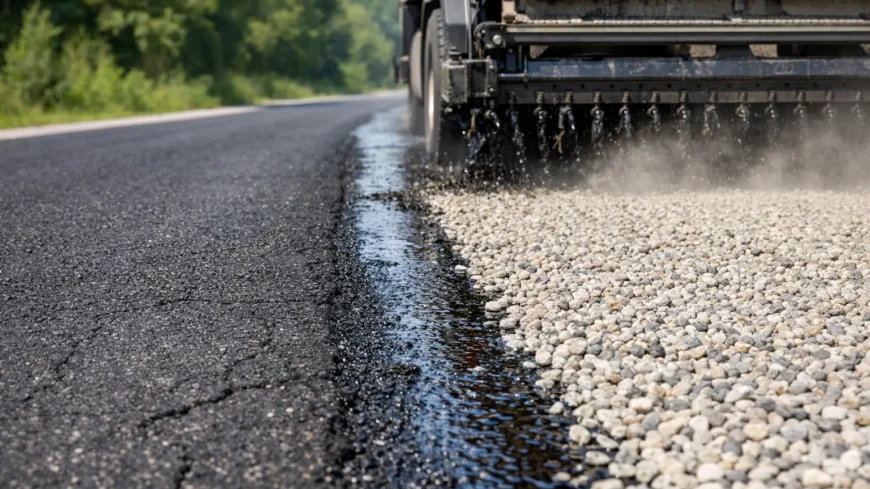
Once the asphalt is confirmed as suitable and properly prepared, a hot bitumen binder is sprayed across the surface. Clean stone chippings are then spread evenly over that binder and rolled in so they bed down securely. Excess loose stone is dealt with as the surface settles.
The result is a textured wearing surface that grips well and gives a fresh appearance. On the right base, it can perform very well and offer a practical alternative to a completely new asphalt finish.
What clients need to understand is that tar and chip is not meant to look like machine-laid tarmac. It has a different character. It is more rustic, more textured, and naturally less uniform. For many properties that is part of the appeal, but expectations should be realistic from the outset.
Benefits of choosing tar and chip over asphalt
The main advantage is value. If the asphalt underneath is still serviceable, overlaying it with tar and chip can save considerable money compared with a full dig out and reconstruction. You are making use of the existing structure rather than paying to remove and replace it unnecessarily.
It also improves traction, which can be useful on sloping driveways or access roads where a smoother finish may become slippery in poor weather. The finished surface is generally hard-wearing and well suited to private roads, farms, larger driveways, and commercial access routes.
Appearance is another factor. Fresh tar and chip can smarten up a surface that looks dated or patchy, and the aggregate choice allows a more decorative finish than plain black surfacing alone.
For clients focused on minimising disruption, it can also be a practical route. Where the underlying asphalt is retained, the job is often simpler than full reconstruction.
Trade-offs to keep in mind
There are trade-offs, and a reliable contractor should be honest about them. Tar and chip has a looser, more natural look than asphalt or block paving. If you want a very crisp, uniform, premium finish, it may not be your preferred option.
There can also be some initial loose chippings after installation. That is normal to a degree, although proper application and aftercare keep this under control. Surface noise is another consideration. The texture can be slightly noisier under tyres than smooth asphalt.
Longevity depends heavily on preparation and on the condition of the substrate. If the asphalt base is only borderline acceptable, the finished result may not last as well as the client hopes. That is why the cheapest quote is not always the best value.
Is tar and chip better than resurfacing with new asphalt?
It depends on the condition of the site and what you want from the finished surface. If the existing asphalt is basically sound and you like the look and function of tar and chip, overlaying can be an excellent choice. It gives fresh life to a worn surface without the cost of a complete rebuild.
If the asphalt is extensively damaged, heavily trafficked, or you need a smoother, more uniform finish for a formal driveway, car park, or forecourt, resurfacing with new asphalt may be the stronger option. For some commercial sites, especially those with frequent turning traffic, a different specification may be more appropriate.
This is where practical site advice makes all the difference. A good contractor should not push one finish for every surface. They should assess the area, explain what is viable, and recommend the option that will perform best over time.
Getting the decision right
If you are asking can you tar and chip over asphalt, the real question is whether your asphalt is still doing its job. If it is stable, well-drained, and repairable, tar and chip can be a smart and cost-effective upgrade. If it is failing underneath, covering it will only delay a larger problem.
For homeowners, businesses, and site managers, the safest route is always a proper assessment rather than a guess based on appearance alone. A surface can look rough and still be suitable, or look acceptable at a glance and actually be failing below. The right recommendation saves money, avoids repeat work, and gives you a finish that lasts.
If you are weighing up your options, focus less on the quickest cosmetic fix and more on what the surface needs to perform properly for years ahead.