
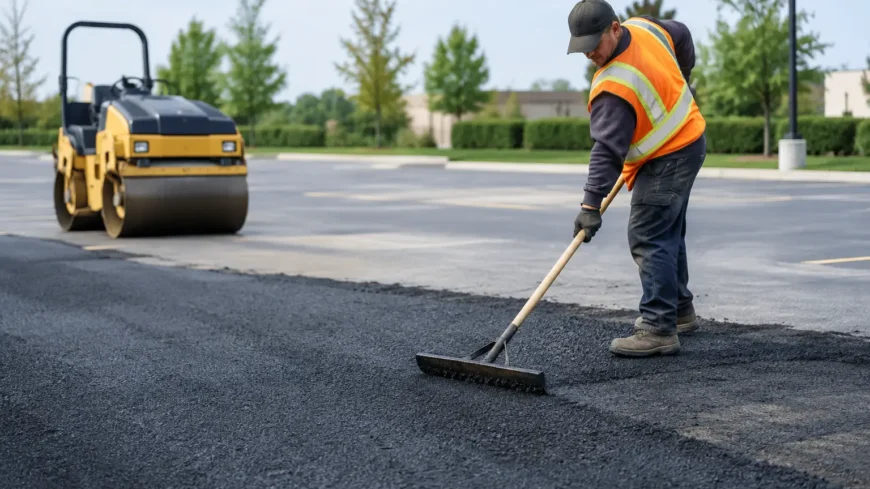
A car park can look serviceable from a distance while hiding a costly problem under every passing vehicle. Potholes, alligator cracking, standing water and crumbling edges are not simply untidy. They create trip hazards, damage vehicles, affect access and can leave a business or property manager exposed to complaints. This asphalt repair project example shows how a planned repair can deal with the cause of failure rather than merely covering the visible damage.
The scenario is representative of the type of work carried out on commercial sites across Scotland. Every surface needs its own survey and specification, but the principles are the same: assess the ground properly, repair failed areas to the right depth, control water and leave a durable finish that can cope with daily use.
The site problem: failing bays and ponding water
The example site was a medium-sized customer car park beside a busy commercial property. It had a mix of defects: several potholes in the wheel tracks, widespread cracking around parking bays, depressions that held water after rain, and loose material at the entrance where delivery vehicles turned sharply.
Previous patch repairs had kept the site open, but they had not stopped the deterioration. Water had entered through cracked asphalt, softened parts of the underlying foundation and allowed traffic to break the surface apart. Applying a thin layer of fresh tarmac over these areas would have improved the appearance for a short time, but it would not have provided a dependable repair.
The client’s priorities were clear. The car park had to remain accessible where possible, the work had to be completed with minimal disruption, and the repaired areas needed to match the level and finish of the sound existing surface. Safety for customers, staff and contractors was central to the plan.
Asphalt repair project example: the right scope of work
A site inspection identified which areas could be repaired locally and which required more substantial excavation. This distinction protects the budget. Not every crack calls for full reconstruction, but a surface that has failed because its base has weakened needs more than a cosmetic patch.
The repair specification divided the work into three parts. Localised potholes and broken edges would be cut out and reinstated. The depressed section where water collected would be excavated to inspect and rebuild the underlying layers. Finally, the entrance and turning area would receive a larger repair designed for repeated loading from vans, lorries and regular traffic.
Before work began, the team marked service covers, kerb lines, pedestrian routes and traffic movements. The site was then split into manageable sections so that part of the car park could remain operational. On a smaller private driveway, a full closure may be the quickest and most cost-effective option. On a commercial site, phased working is often worth the additional organisation because it reduces lost access.
Cutting out failed asphalt
Each defective area was saw-cut into a clean, regular shape. This gives the new material a strong, defined joint with the surrounding surface and prevents the repair from feathering out at weak, broken edges. Loose and damaged asphalt was removed down to the depth required by the condition of the base.
The team did not assume that every pothole was the same. In shallow failures, the lower layer remained firm and only the surface course needed replacement. In the deeper depressions, the sub-base was soft and contaminated with water. That material had to be removed before a new repair could be built properly.
This is where good workmanship has the greatest effect on lifespan. A patch can look neat on the day it is laid, but if unstable material remains below it, traffic will soon cause it to crack, sink or break around the edges.
Rebuilding the foundation and managing water
Once the weak ground had been excavated, the exposed formation was checked. Suitable aggregate was installed in layers and compacted with the correct plant to create a stable foundation. The depth depended on the excavation and expected loading. Heavier vehicle areas need a stronger construction than a lightly used pedestrian route or domestic parking space.
The ponding area also needed a correction to its levels. Water is one of asphalt’s biggest enemies, particularly through a Scottish winter. The repaired section was shaped to direct surface water towards the existing drainage route rather than allowing it to sit in the wheel track.
Drainage is sometimes the deciding factor between patching and resurfacing. If water is trapped because gullies are blocked, falls are wrong or the surface has settled across a wide area, local repairs alone may not be enough. A responsible contractor should explain this before work starts, not after the new asphalt has been laid.
Laying and compacting new asphalt
After the base was prepared, a regulating layer was used where needed to restore the correct profile. New asphalt was then laid to the specified thickness and compacted while at the appropriate temperature. Proper compaction removes voids, improves strength and helps the repair resist water penetration.
The edges were sealed carefully to reduce the chance of water finding its way into the joint. The finished repairs were level with the surrounding surface, allowing vehicles to pass without a jolt and avoiding low spots that could collect water again.
The entrance turning area received particular attention. High-turning forces can push and tear at asphalt, especially where delivery vehicles turn their wheels while stationary. In locations like this, the material choice, depth and sub-base strength all need to reflect the use of the area. A repair suitable for a domestic driveway may not be suitable for a forecourt or service yard.
Keeping the car park safe while works are underway
A good repair is judged by more than the finished tarmac. The way work is managed matters just as much on an occupied site. The contractor agreed working hours with the client, placed clear barriers and signs around each section, and maintained a safe route for pedestrians.
Excavated material was removed promptly rather than left where it could obstruct customers or deliveries. Plant movements were controlled, and the work area was kept tidy at the end of each shift. For sites with limited access, early planning avoids the common problem of having a repair crew, delivery vehicles and customers all trying to use the same narrow entrance.
Weather also affects the programme. Asphalt work requires suitable ground and air conditions, particularly where larger areas are being laid. A contractor should not rush work in poor conditions simply to meet an unrealistic date. It is better to schedule the work correctly than compromise the bond, compaction or finish.
White lining and final presentation
Once the asphalt had cooled sufficiently, the parking bay markings and directional arrows were reinstated. Fresh white lining made the repaired car park easier to use, improved traffic flow and gave the whole site a more professional appearance.
This final stage is often overlooked when budgets are prepared. Yet a repaired surface without clear markings can still create confusion, wasted space and avoidable minor collisions. On commercial sites, lining should be considered part of the usable finished surface, not an optional extra.
A final inspection checked the levels, joints, drainage falls and appearance before the barriers were removed. The client received clear advice on when the repaired areas could take normal traffic and on practical maintenance, including keeping gullies clear and dealing with new cracks before water gets underneath the surface.
What this repair achieved
The completed work removed immediate hazards, restored a smoother route through the car park and stopped water from collecting in the worst affected area. More importantly, it replaced failed material below the surface rather than hiding the problem with a thin overlay.
The project also demonstrated why the cheapest quotation is not always the best value. A lower price may cover a superficial patch, while a properly specified repair includes excavation, disposal, base reinstatement, compaction and edge sealing. The right option depends on the condition of the site, expected traffic and how long the client needs the repair to last.
For homeowners, the same approach applies to a cracked driveway, worn entrance or pothole near a garage. For facilities managers and property owners, it applies across car parks, access roads, forecourts and loading areas. Roadsafe Surfacing Ltd assesses the failure first, then recommends a repair that is practical for the site, budget and level of use.
If an asphalt surface is beginning to crack, sink or hold water, early action is usually simpler than waiting for a full failure. A clear survey and an honest repair plan can protect access, improve safety and keep a manageable defect from becoming a larger resurfacing job.