
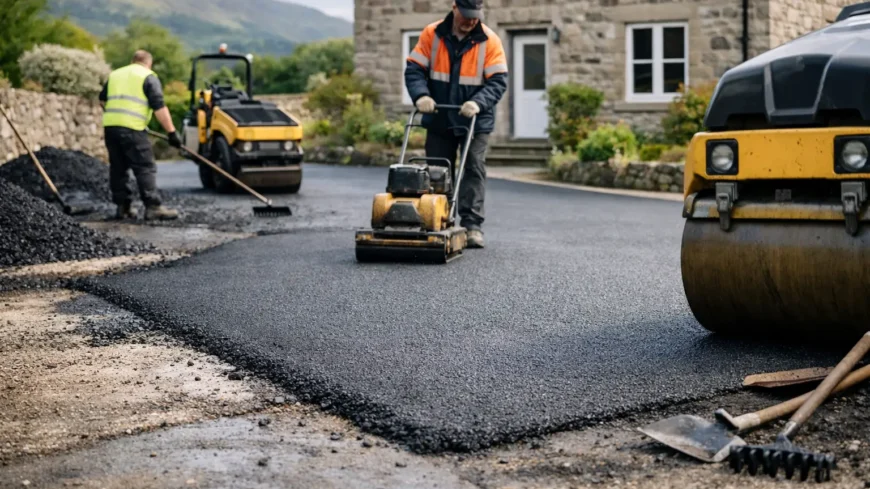
A driveway rarely fails all at once. It starts with loose stone at the edges, a shallow dip that holds rainwater, or cracks that widen after another Scottish winter. By the time you are looking into driveway resurfacing Scotland property owners often want the same thing – a surface that looks smart, drains properly and stands up to daily use without constant patching.
Resurfacing can be an excellent option, but it is not always the right one. The key is knowing when the existing base is still sound and when a full replacement will save money and disruption in the long run. That is where experienced assessment matters. A good contractor will not sell resurfacing simply because it is quicker. They will tell you honestly whether your driveway has enough structural integrity to justify it.
When driveway resurfacing in Scotland makes sense
Resurfacing is usually the best fit when the top layer is tired, worn or cosmetically poor, but the foundation underneath remains stable. If your driveway has minor surface cracking, faded appearance, light fretting or a rough finish, a new wearing course can transform it without the cost of digging everything out.
For many homeowners, this is the sweet spot. You improve kerb appeal, restore a cleaner and more even finish, and extend the life of the driveway without starting from scratch. For commercial sites, resurfacing can also reduce downtime. A car park, forecourt or access road often benefits from a new top layer if the sub-base is still doing its job.
That said, resurfacing is not a cover-up for serious failure. If the driveway is sinking, breaking apart over large areas, or suffering from drainage problems caused by movement below the surface, laying new material on top will not solve the root issue. It may look better for a while, but the defects usually return.
What a contractor should check before resurfacing
The quality of the finished job depends heavily on what happens before any new surfacing is laid. A proper survey should look at the condition of the existing base, the depth and spread of cracks, edge stability, levels around the property, and how water moves across the surface.
Drainage is especially important in Scotland. Heavy rainfall and repeated freeze-thaw cycles put pressure on weak spots. If water sits on the driveway or runs towards the house, garage or pavement, resurfacing alone may not be enough. Levels may need adjusting, channels may need adding, or damaged sections may need localised repair first.
Access also matters. A narrow domestic drive in Edinburgh is a different working environment from a larger rural property in East Lothian or a busy shared access point serving several users. The right contractor will plan the works around the site, not force the site to fit a standard approach.
Tarmac, asphalt and other resurfacing options
For most driveways, tarmac and asphalt remain the most practical resurfacing choices. They are hard-wearing, cost-effective and well suited to the Scottish climate when properly installed. They also provide a neat, professional finish that works well for both modern and traditional properties.
Tarmac is often chosen for its value and durability. It is particularly good where reliability matters more than decorative detail. Asphalt offers a similarly strong result and can provide a smoother finish depending on the specification used. In both cases, workmanship is the deciding factor. Even the best material will underperform if the preparation, levels and compaction are poor.
Tar and chip can be suitable in some settings, particularly for longer private roads, rural access routes or larger properties where a more textured appearance is preferred. It is not the right answer for every driveway, but in the right setting it can offer a durable and cost-conscious finish.
The right surface depends on budget, usage and appearance. A family driveway with two cars and regular foot traffic has different demands from a commercial forecourt or a site that receives vans and heavier vehicles. There is no single best option for every property.
The process of driveway resurfacing Scotland customers should expect
A professional resurfacing job should feel organised from the start. First comes the site visit and quotation. This is where the contractor assesses whether resurfacing is appropriate, measures the area, checks the existing condition and talks through finish options, edging and any repairs needed beforehand.
The preparation stage is where corners should never be cut. That may involve cleaning the surface, treating weak spots, repairing potholes, cutting out failed sections, adjusting ironwork or edges, and applying the correct bonding treatment. If the surface underneath is not properly prepared, the new layer will only ever be as good as what lies beneath it.
Once the site is ready, the new material is laid and compacted to the correct depth. This is not just about appearance. Proper compaction affects lifespan, water runoff and resistance to wear. The final result should be smooth, tidy and consistent, with clear attention paid to edges, thresholds and transitions to paths or roads.
For commercial sites, there may also be follow-on work such as line marking, bay layout or safety markings. For domestic driveways, the focus is usually on a clean finish, practical access and making sure the driveway is ready for regular use as quickly as possible.
Cost, value and the question every customer asks
Most people want a straight answer on price. The reality is that driveway resurfacing costs depend on size, condition, access, material choice and how much preparatory repair is required. A simple overlay on a sound base is very different from resurfacing that includes patch repairs, drainage adjustments or edge reinstatement.
The cheapest quote is not always the lowest-cost option over time. If the contractor skips preparation, uses inadequate thickness or ignores drainage, the driveway may need attention again far sooner than expected. Value comes from a job done properly, with materials and workmanship that hold up.
That is why clear quoting matters. Customers should understand what is included, what is being repaired, what material is being used and whether there is any guarantee behind the work. Good contractors are happy to explain this in plain terms.
Common problems resurfacing can solve – and those it cannot
Resurfacing is very effective for worn appearance, shallow surface defects, minor cracking, loss of texture and general ageing. It can make an old driveway look significantly newer and improve daily use at the same time.
It is less effective where the real problem is structural. Deep rutting, widespread subsidence, base failure and long-standing drainage faults often point to more extensive work. In those cases, honest advice saves customers from paying twice.
This is where experience shows. A dependable surfacing contractor will look beyond the visible finish and focus on performance. That means asking how the driveway is used, how long the issue has been present and whether heavy vehicles or standing water are part of the problem.
Choosing a contractor for driveway resurfacing in Scotland
You are not just buying material. You are buying judgement, preparation and accountability. The right contractor should be able to assess domestic and commercial surfaces with the same practical mindset – what condition is it in, what will last, and how can the work be completed safely with minimal disruption.
Look for a company that handles more than one type of surfacing work. That usually means they are less likely to push a one-size-fits-all answer. A contractor with experience in driveways, car parks, roads, pothole repairs and line marking tends to understand how surfaces perform under different conditions and traffic levels.
It also helps to choose a team that is clear about timescales, tidy on site and willing to stand behind the job. That matters just as much for a private driveway as it does for a larger commercial contract. Roadsafe Surfacing Ltd works with that mindset – straightforward advice, quality workmanship and a finish built to last.
A better driveway starts with the right decision
If your driveway is looking tired, patching it again may only delay the inevitable. Resurfacing can be a smart, cost-effective solution when the base is sound and the work is carried out properly. The important part is not rushing into the wrong fix.
A good driveway should do more than look better from the street. It should drain well, feel solid underfoot and cope with the demands of daily use year after year. Start with an honest assessment, ask the right questions, and choose a contractor who treats the job as a long-term result rather than a quick sale.