
How to Prevent Winter Driveway Damage in Scotland

By 0
34
How to Prevent Winter Driveway Damage in Scotland

A Scottish winter can turn a small driveway flaw into a costly repair surprisingly quickly. Water finds its way into hairline cracks, freezes overnight, expands and loosens the surface. Add repeated thawing, heavy vehicles, grit and standing water, and a driveway that looked sound in October may be breaking up by spring. To prevent winter driveway damage, the most effective approach is to deal with drainage, defects and day-to-day winter maintenance before freezing weather takes hold.

For homeowners, this protects the appearance and value of the property. For facilities managers and commercial owners, it also helps keep entrances, car parks and access routes safer for staff, visitors and deliveries. The right maintenance is rarely complicated, but timing matters.

Why winter is hard on tarmac and asphalt driveways

Tarmac and asphalt are durable surfaces when properly laid on a stable base with suitable drainage. They are not immune to water, however. Once water enters a crack, joint or weak edge, frost can force it wider. When the ice melts, the void beneath the surface may remain, leaving the area less able to carry vehicle weight.

This freeze-thaw cycle is one of the main reasons potholes develop. A tyre passing over a weakened spot can break away loose material, particularly where cars regularly brake, turn or park. Driveway edges are also vulnerable because they receive less support than the middle of the surface.

Winter damage is not always caused by frost alone. Poor drainage can leave water sitting on the drive for days, softening weak areas and washing fine material from the base. A blocked channel drain, overflowing gutter or downpipe discharging straight onto the surface can create the same repeating problem in one location.

Inspect the driveway before the first hard frost

The best time to assess a driveway is during autumn, when the surface is dry enough to see its condition clearly and there is still time to carry out repairs. Walk the full area rather than checking only the route to the front door or garage.

Look for fine cracks, open joints, loose stones, crumbling edges, depressions where puddles form and patches that feel uneven underfoot. On tarmac, a pale or dry-looking finish can also suggest that the surface is ageing and may benefit from professional treatment or repair. On tar and chip surfaces, check for areas where aggregate has become loose or where the binder appears worn.

Small defects should not be dismissed as cosmetic. A narrow crack may be straightforward to seal in mild weather, while the same crack after a season of frost can become a broken section requiring a more substantial repair. If there is a pothole, movement in the surface or a spreading soft patch, it is worth arranging an assessment before winter rather than waiting for the problem to grow.

Pay attention to drainage routes

Drainage should move water away from the driveway, building and neighbouring ground without allowing it to collect at a low point. Clear leaves, soil and gravel from gullies, channels and grates. Check that gutters are not overflowing and that downpipes discharge into suitable drainage rather than across the driveway.

If puddles repeatedly return in the same place, simply sweeping water away is not a long-term fix. The cause may be a local dip, inadequate falls, a blocked drain or failure beneath the surface. A contractor can identify whether localised levelling, drainage work or resurfacing is the sensible option. The right repair depends on the condition of the base, not just what can be seen from above.

Prevent winter driveway damage with careful de-icing

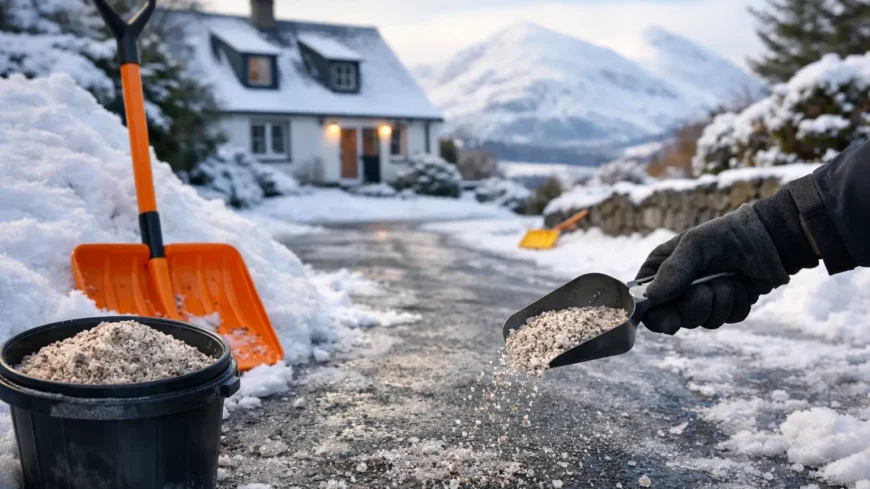
De-icing makes access safer, but the wrong approach can create avoidable wear. Use a suitable de-icing salt sparingly and spread it evenly over walking routes, entrance areas and the sections where vehicles need traction. Applying excessive amounts does not necessarily melt ice faster, and loose salt can be carried indoors or into surrounding planting areas.

For tarmac and asphalt driveways, avoid aggressive chemical products unless they are confirmed as suitable for the surface. Some de-icers and household products can be harsher on materials, nearby paving, metalwork and planting than standard rock salt. If the driveway has decorative stone edging or is close to lawns and beds, use only what is needed and sweep up remaining granules once conditions improve.

Do not pour boiling water over an icy driveway. It may appear to solve the immediate problem, but rapid temperature changes are unhelpful for a surface already exposed to frost. The water can also refreeze quickly and create a more dangerous layer of ice.

A stiff brush or plastic shovel is usually a better choice for clearing snow. Avoid metal-edged tools that can gouge tarmac, dislodge tar and chip aggregate or catch on raised repairs. Clear snow in layers rather than scraping hard against the surface, especially where the driveway is uneven or you cannot see the edge clearly.

Keep heavy loads off weak areas

Many residential driveways are designed for cars and light vans, not regular visits from heavy lorries, skips or construction plant. During winter, when the ground and sub-base may be wetter, the load-bearing capacity of a weak driveway can be reduced further.

If a delivery vehicle, skip or contractor vehicle must use the drive, agree the route in advance and keep it away from edges, drainage covers and visibly damaged areas. Do not assume a thick-looking surface can handle any load. The durability of a driveway depends as much on its foundation and edge restraint as its finished top layer.

Commercial sites should also monitor areas exposed to repeated turning movements. Delivery bays, bin-store entrances, vehicle gates and parking spaces near building entrances often show wear first. Dealing with isolated failures early can prevent disruption across the wider site later in the season.

Deal with potholes and cracks promptly

Temporary cold-weather repairs have their place when a pothole presents an immediate trip hazard or threatens vehicle damage. They can make an area safe until permanent work is practical. However, a lasting repair usually requires the damaged material to be cut back to sound edges, the base checked and reinstated, then the surface properly compacted.

Patching only the top of a pothole without addressing a failed base can be a false economy. The patch may look neat initially but move or break up once water returns. This is particularly relevant where a pothole has formed beside a drain, on a slope or in a route used daily by vehicles.

Crack sealing is most effective before cracks become wide, contaminated or broken at the edges. If the driveway has widespread cracking, extensive ponding or multiple patches, isolated repairs may no longer offer the best value. A professional survey can establish whether resurfacing, overlaying or full reconstruction is the more dependable investment.

Protect edges, kerbs and adjoining surfaces

Driveway edges are easy to overlook, yet they are often the first areas to crack when vehicles mount them or tyres repeatedly run close to the boundary. Keep wheels away from unrestrained edges where possible, particularly when reversing in poor light or snow. If an edge is crumbling, repair it before water reaches the layers below.

Take care around drainage channels, inspection covers and transitions between the driveway and pavement, garage threshold or road. These points are naturally exposed to movement and can become trip hazards when surface levels deteriorate. Good edge restraint and properly finished joints are small construction details that make a significant difference through repeated winters.

Know when to call a surfacing contractor

There is a clear difference between routine upkeep and signs of structural failure. Surface cleaning, sensible de-icing and clearing drains are useful owner-maintenance tasks. Soft spots, recurring potholes, major cracks, standing water and sinking areas need a closer look.

For properties and sites across Edinburgh, East Lothian and wider Scotland, winter repairs should be planned around weather conditions, access requirements and safety. Roadsafe Surfacing Ltd can assess damaged tarmac, asphalt and tar and chip surfaces, advise on the most practical repair and carry out emergency pothole work where hazards cannot wait.

A driveway does not need to look perfect to get through winter well. It needs to shed water, carry the loads placed on it and have small faults dealt with before frost turns them into larger failures. A short inspection and timely repair now can keep your access safer, cleaner and more dependable when the weather turns.

Leave a reply

Your email address will not be published. Required fields are marked *

Your Name:*

Your Website

Your Comment

How to Prevent Winter Driveway Damage in Scotland

By 0
0
How to Prevent Winter Driveway Damage in Scotland

A Scottish winter can turn a small driveway flaw into a costly repair surprisingly quickly. Water finds its way into hairline cracks, freezes overnight, expands and loosens the surface. Add repeated thawing, heavy vehicles, grit and standing water, and a driveway that looked sound in October may be breaking up by spring. To prevent winter driveway damage, the most effective approach is to deal with drainage, defects and day-to-day winter maintenance before freezing weather takes hold.

For homeowners, this protects the appearance and value of the property. For facilities managers and commercial owners, it also helps keep entrances, car parks and access routes safer for staff, visitors and deliveries. The right maintenance is rarely complicated, but timing matters.

Why winter is hard on tarmac and asphalt driveways

Tarmac and asphalt are durable surfaces when properly laid on a stable base with suitable drainage. They are not immune to water, however. Once water enters a crack, joint or weak edge, frost can force it wider. When the ice melts, the void beneath the surface may remain, leaving the area less able to carry vehicle weight.

This freeze-thaw cycle is one of the main reasons potholes develop. A tyre passing over a weakened spot can break away loose material, particularly where cars regularly brake, turn or park. Driveway edges are also vulnerable because they receive less support than the middle of the surface.

Winter damage is not always caused by frost alone. Poor drainage can leave water sitting on the drive for days, softening weak areas and washing fine material from the base. A blocked channel drain, overflowing gutter or downpipe discharging straight onto the surface can create the same repeating problem in one location.

Inspect the driveway before the first hard frost

The best time to assess a driveway is during autumn, when the surface is dry enough to see its condition clearly and there is still time to carry out repairs. Walk the full area rather than checking only the route to the front door or garage.

Look for fine cracks, open joints, loose stones, crumbling edges, depressions where puddles form and patches that feel uneven underfoot. On tarmac, a pale or dry-looking finish can also suggest that the surface is ageing and may benefit from professional treatment or repair. On tar and chip surfaces, check for areas where aggregate has become loose or where the binder appears worn.

Small defects should not be dismissed as cosmetic. A narrow crack may be straightforward to seal in mild weather, while the same crack after a season of frost can become a broken section requiring a more substantial repair. If there is a pothole, movement in the surface or a spreading soft patch, it is worth arranging an assessment before winter rather than waiting for the problem to grow.

Pay attention to drainage routes

Drainage should move water away from the driveway, building and neighbouring ground without allowing it to collect at a low point. Clear leaves, soil and gravel from gullies, channels and grates. Check that gutters are not overflowing and that downpipes discharge into suitable drainage rather than across the driveway.

If puddles repeatedly return in the same place, simply sweeping water away is not a long-term fix. The cause may be a local dip, inadequate falls, a blocked drain or failure beneath the surface. A contractor can identify whether localised levelling, drainage work or resurfacing is the sensible option. The right repair depends on the condition of the base, not just what can be seen from above.

Prevent winter driveway damage with careful de-icing

De-icing makes access safer, but the wrong approach can create avoidable wear. Use a suitable de-icing salt sparingly and spread it evenly over walking routes, entrance areas and the sections where vehicles need traction. Applying excessive amounts does not necessarily melt ice faster, and loose salt can be carried indoors or into surrounding planting areas.

For tarmac and asphalt driveways, avoid aggressive chemical products unless they are confirmed as suitable for the surface. Some de-icers and household products can be harsher on materials, nearby paving, metalwork and planting than standard rock salt. If the driveway has decorative stone edging or is close to lawns and beds, use only what is needed and sweep up remaining granules once conditions improve.

Do not pour boiling water over an icy driveway. It may appear to solve the immediate problem, but rapid temperature changes are unhelpful for a surface already exposed to frost. The water can also refreeze quickly and create a more dangerous layer of ice.

A stiff brush or plastic shovel is usually a better choice for clearing snow. Avoid metal-edged tools that can gouge tarmac, dislodge tar and chip aggregate or catch on raised repairs. Clear snow in layers rather than scraping hard against the surface, especially where the driveway is uneven or you cannot see the edge clearly.

Keep heavy loads off weak areas

Many residential driveways are designed for cars and light vans, not regular visits from heavy lorries, skips or construction plant. During winter, when the ground and sub-base may be wetter, the load-bearing capacity of a weak driveway can be reduced further.

If a delivery vehicle, skip or contractor vehicle must use the drive, agree the route in advance and keep it away from edges, drainage covers and visibly damaged areas. Do not assume a thick-looking surface can handle any load. The durability of a driveway depends as much on its foundation and edge restraint as its finished top layer.

Commercial sites should also monitor areas exposed to repeated turning movements. Delivery bays, bin-store entrances, vehicle gates and parking spaces near building entrances often show wear first. Dealing with isolated failures early can prevent disruption across the wider site later in the season.

Deal with potholes and cracks promptly

Temporary cold-weather repairs have their place when a pothole presents an immediate trip hazard or threatens vehicle damage. They can make an area safe until permanent work is practical. However, a lasting repair usually requires the damaged material to be cut back to sound edges, the base checked and reinstated, then the surface properly compacted.

Patching only the top of a pothole without addressing a failed base can be a false economy. The patch may look neat initially but move or break up once water returns. This is particularly relevant where a pothole has formed beside a drain, on a slope or in a route used daily by vehicles.

Crack sealing is most effective before cracks become wide, contaminated or broken at the edges. If the driveway has widespread cracking, extensive ponding or multiple patches, isolated repairs may no longer offer the best value. A professional survey can establish whether resurfacing, overlaying or full reconstruction is the more dependable investment.

Protect edges, kerbs and adjoining surfaces

Driveway edges are easy to overlook, yet they are often the first areas to crack when vehicles mount them or tyres repeatedly run close to the boundary. Keep wheels away from unrestrained edges where possible, particularly when reversing in poor light or snow. If an edge is crumbling, repair it before water reaches the layers below.

Take care around drainage channels, inspection covers and transitions between the driveway and pavement, garage threshold or road. These points are naturally exposed to movement and can become trip hazards when surface levels deteriorate. Good edge restraint and properly finished joints are small construction details that make a significant difference through repeated winters.

Know when to call a surfacing contractor

There is a clear difference between routine upkeep and signs of structural failure. Surface cleaning, sensible de-icing and clearing drains are useful owner-maintenance tasks. Soft spots, recurring potholes, major cracks, standing water and sinking areas need a closer look.

For properties and sites across Edinburgh, East Lothian and wider Scotland, winter repairs should be planned around weather conditions, access requirements and safety. Roadsafe Surfacing Ltd can assess damaged tarmac, asphalt and tar and chip surfaces, advise on the most practical repair and carry out emergency pothole work where hazards cannot wait.

A driveway does not need to look perfect to get through winter well. It needs to shed water, carry the loads placed on it and have small faults dealt with before frost turns them into larger failures. A short inspection and timely repair now can keep your access safer, cleaner and more dependable when the weather turns.

Leave a reply

Your email address will not be published. Required fields are marked *

Your Name:*

Your Website

Your Comment