
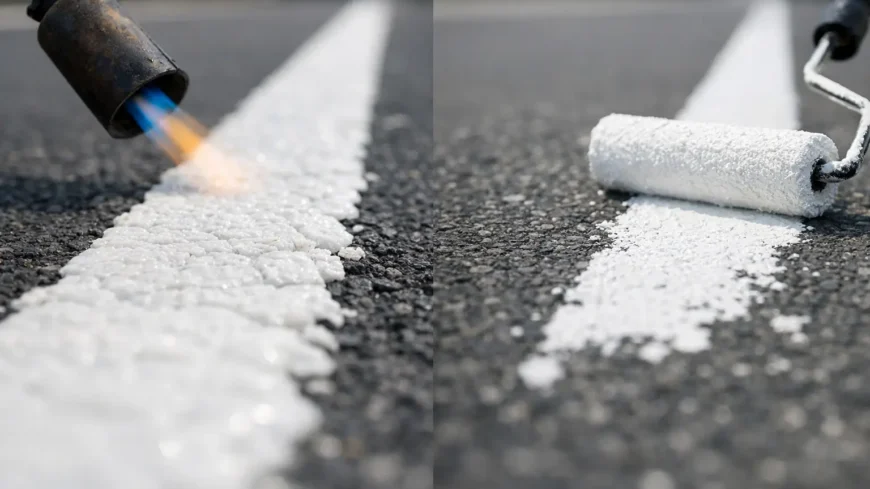
A faded bay line or worn pedestrian crossing is not just an appearance issue. On a busy car park, private road or forecourt, unclear markings can create confusion, restrict access and increase risk for drivers and pedestrians. When weighing up thermoplastic vs painted lines, the right answer depends on traffic levels, surface condition, programme, budget and how long the markings need to perform.
Both systems have a place. Painted lines can be a practical, economical solution for many private sites, while thermoplastic markings are built for demanding locations where visibility and durability matter most. The key is matching the material to the work, rather than paying for more than the site requires or choosing a cheaper option that needs attention too soon.
Thermoplastic vs painted lines: the core difference
Painted line markings are applied cold, usually with specialist line-marking paint. Depending on the product and surface, they may be water-based, solvent-based or two-pack. They dry quickly, can be applied accurately with line-marking equipment and are suitable for a wide range of parking bays, directional arrows, hatchings, court lines and access routes.
Thermoplastic is a pre-mixed marking material that is heated before application. Once laid onto the prepared surface, it cools to form a thicker, more substantial marking. Glass beads are commonly incorporated or added to improve night-time reflectivity, while anti-skid aggregates can be used where additional grip is needed.
The visible result may look similar from a distance, particularly when both are newly installed. The difference becomes clearer under tyre wear, regular turning movements, poor weather and repeated use. Thermoplastic is generally the more hard-wearing option. Paint is generally easier to install, refresh and adapt.
Durability under traffic and Scottish weather
Traffic is normally the biggest factor in line-marking lifespan. A lightly used residential development, small office car park or private yard does not subject markings to the same forces as a supermarket car park, delivery route or busy access road. Braking, turning tyres and HGV movements are especially abrasive, often wearing the centre of bays, give-way lines and directional arrows first.
Where thermoplastic earns its cost
Thermoplastic is well suited to high-traffic areas, public-access routes and locations where markings need to stay sharp for longer. Its thickness makes it more resistant to wear than conventional paint, and its reflective finish can improve visibility in poor light when the correct beads and application are used.
For road markings, main access routes, pedestrian crossings, disabled bays and heavily used car parks, a thermoplastic system can reduce the frequency of remarking. This is particularly valuable where closing part of a site causes disruption to customers, staff or residents.
However, thermoplastic is not a cure for a failing surface. If tarmac is cracked, fretting, contaminated with oil or breaking up, the marking will only perform as well as the surface beneath it. Pothole repairs, patching or resurfacing may be the more sensible first step.
When painted lines are the sensible choice
Painted lines are often the right solution for lower-traffic sites, temporary layouts and markings that may need to change. For example, a business reorganising its parking arrangement, a developer handing over a new site, or a school refreshing game-court markings may benefit from paint’s flexibility and lower initial cost.
Paint can also be useful where a quick turnaround is essential, provided weather and surface conditions allow. A professional contractor will still need a clean, dry surface for proper adhesion. Applying paint to damp tarmac or over loose material may look acceptable on day one, but it can lead to early peeling and patchy wear.
The trade-off is maintenance. Painted markings will usually need refreshing sooner in areas with regular vehicle movements, particularly at junctions, loading bays and entrances.
Initial price is only part of the cost
It is understandable to compare quotations by the immediate installation price. In many cases, painted markings cost less upfront because the materials and application process are simpler. That can be the best-value decision where use is light and the site has a limited maintenance budget.
Thermoplastic normally costs more initially, partly because it requires specialist heating equipment, trained operatives and more thorough planning around application conditions. Yet a higher first cost can make financial sense if it avoids repeated closures and frequent repainting over the years.
The better question is not simply, “Which marking is cheaper?” It is, “What will this site cost to maintain while staying safe and presentable?” For a customer-facing car park, worn markings can affect first impressions as well as day-to-day safety. For a facilities manager, each return visit means arranging access, notifying users and managing disruption.
A clear quotation should set out the marking material, preparation required, layout, colour, reflective or anti-skid finish where applicable, and any restrictions on traffic returning to the area. This makes it easier to compare like for like.
Choose the line-marking system around the site
The most suitable option should reflect the actual use of the space. There is no benefit in specifying road-grade thermoplastic throughout a quiet private car park if a well-applied paint system will perform properly. Equally, applying basic paint to a heavily trafficked entry lane can be false economy.
For a busy commercial car park, thermoplastic is often preferable for priority markings, pedestrian routes, arrows, loading areas and disabled parking bays. These are the markings users rely on most, so they should remain clear through rain, darkness and regular traffic.
For residential developments and smaller business premises, painted bay lines may offer an excellent balance of cost, neatness and service life. The same applies to temporary route changes, construction compounds and evolving layouts where the marking plan may not be permanent.
For schools, leisure sites and game courts, the choice is more specific. Paint is widely used for court lines because it allows precise layouts and colour options, but the selected coating must suit the surface and expected use. A surface used for vehicles requires a different approach from one designed for play.
Preparation determines the finish
Whether the job uses paint or thermoplastic, correct preparation is non-negotiable. The surface should be sound, dry and free from dust, loose aggregate, oil, moss and other contaminants. Existing failed markings may need removing or treating so they do not show through or compromise adhesion.
Freshly laid tarmac also needs appropriate curing time before permanent markings are applied. Marking too early can lead to poor bonding or discolouration as oils migrate from the new surface. On concrete, a suitable primer may be required, particularly for thermoplastic applications.
Layout matters just as much. Bay widths, access aisles, turning space, pedestrian routes and fire access must work together. On sites used by the public, markings should support safe movement rather than simply fill available space. If a layout needs to meet a particular client, landlord, accessibility or highway requirement, it should be agreed before work begins.
Visibility, safety and finishing details
White lines are only useful if people can see and understand them. Strong contrast against the surface, clean edges and logical positioning all help. In poorly lit areas, reflective glass beads can make a significant difference to visibility in vehicle headlights, especially on access roads and entrances.
Anti-skid finishes may also be appropriate for approaches, crossings, cycle areas and locations where vehicles brake or turn. They are not necessary for every line, but they can be a sensible safety measure where the risk justifies it.
Colour choice should be practical rather than decorative. White is common for bays and general road markings, yellow is frequently used for restrictions or no-parking areas, and coloured markings may identify pedestrian, cycle or emergency routes. Consistency matters. A site becomes safer when users can read it at a glance.
Get a recommendation based on the surface, not a standard package
A proper site assessment should look at the existing surface, drainage, traffic type, layout and the condition of any old markings. It should also consider when the work can be completed with the least inconvenience. For occupied commercial premises, that may mean scheduling outside peak hours or completing the work in phases.
Roadsafe Surfacing Ltd provides practical line-marking recommendations for private and commercial sites across Scotland, alongside the surfacing repairs that often make a longer-lasting finish possible. The aim is straightforward: clear markings, sound preparation and a solution that fits the way the site is actually used.
If your bays, arrows or pedestrian routes are fading, do not wait until users are guessing where to go. A short site review can establish whether repainting is enough, whether thermoplastic will offer better long-term value, or whether the surface needs repair before any new lines are applied.