
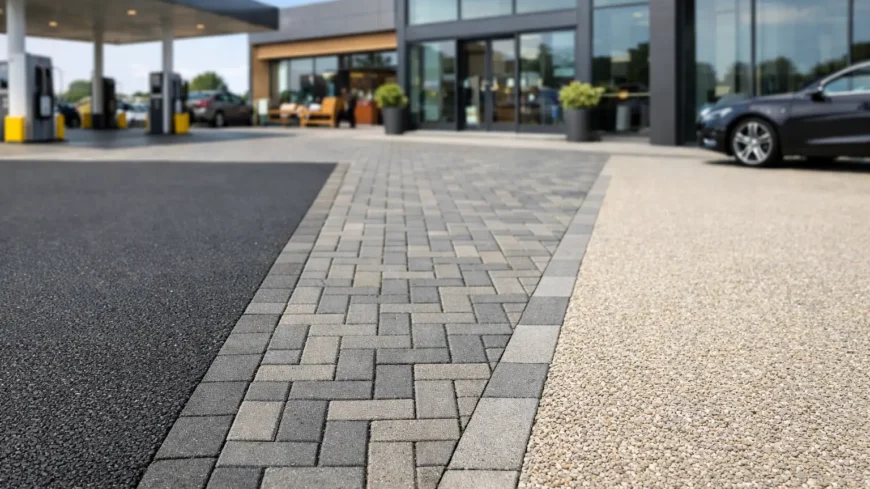
A forecourt has to work hard from the first vehicle arrival to the last delivery of the day. It is the entrance to your premises, a traffic route, a parking area and a safety-critical surface all at once. Choosing the best surfacing for commercial forecourts is therefore not simply a matter of picking the finish that looks smartest on day one. It is about specifying a surface that can cope with traffic, weather, drainage and maintenance without creating unnecessary disruption or cost.
For most commercial sites, properly installed tarmac or asphalt is the practical first choice. However, the right answer depends on the type and volume of vehicles using the area, the condition of the existing ground, the drainage layout and the standard of appearance your business needs to maintain.
What a Commercial Forecourt Surface Must Handle
Commercial forecourts face pressures that a private driveway rarely sees. Cars turn tightly near entrances, vans stop repeatedly, delivery lorries can place heavy loads on the same areas, and pedestrians cross between parked vehicles. Fuel, oil, grit, standing water and the Scottish weather all add to the challenge.
A good surface must provide reliable grip, shed water effectively and remain level under regular use. It also needs clearly defined areas for parking, access, loading and pedestrian movement. A surface may appear sound overall but still become a liability if potholes, loose chippings, cracking or faded line markings make the site harder to use safely.
The foundation below the finished surface matters just as much as the material on top. If the sub-base is weak, poorly compacted or unable to manage water, even high-quality asphalt will fail earlier than it should. This is why a proper site assessment should come before any recommendation or quotation.
Best Surfacing for Commercial Forecourts: The Main Options
Tarmac and asphalt
Tarmac and asphalt are often the best all-round surfacing options for commercial forecourts. They create a smooth, durable finish that works well for cars, vans and most routine commercial traffic. When installed over the correct base course and laid to appropriate thickness, asphalt gives a clean, professional appearance while remaining practical to repair and maintain.
It is particularly well suited to forecourts where vehicles are continually entering, parking and manoeuvring. It can also be laid around drainage channels, kerbs, access points and existing features with a tidy result. White lining can then be applied to organise parking bays, directional arrows, disabled spaces, pedestrian walkways and loading zones.
The specification needs to match the site. A light-use office forecourt does not require the same construction as a builders’ merchant, industrial unit or depot receiving loaded lorries. Heavy-use areas may need a stronger sub-base, thicker asphalt layers and additional attention around turning circles, gates and loading points where stress is concentrated.
Tar and chip
Tar and chip combines a bitumen binder with loose aggregate pressed into the surface. It offers a more textured, traditional appearance than conventional tarmac and is available in a choice of aggregate colours. For commercial premises where presentation matters, it can give an entrance or parking area a distinctive finish without the cost of block paving.
Its textured surface can offer useful grip, and it is a sensible option for lower-speed car parks, private business entrances and rural commercial sites. It is less suitable where there is frequent heavy turning traffic, as aggressive manoeuvring can disturb the aggregate over time. It also needs careful installation and an appropriate period for the surface to settle.
Concrete
Concrete can be a strong choice for dedicated loading areas, wash-down zones and locations subjected to repeated heavy point loads. It can withstand demanding use, but it is not automatically the best option for an entire forecourt. The higher initial cost, joint detailing, longer curing time and more involved repairs can make it less flexible than asphalt for general vehicle circulation and parking areas.
A mixed approach often makes better commercial sense. Asphalt can be used across the main forecourt, with concrete reserved for areas where heavy lorries stop, skip lorries operate or equipment is regularly positioned.
Block paving and decorative finishes
Block paving can create an attractive entrance area, particularly for hospitality, retail or office premises. It can also be lifted locally to access underground services. But it is not the low-maintenance answer many property owners expect. Under commercial traffic, blocks can move, joints can open and settlement can lead to uneven surfaces if the ground preparation is inadequate.
For high-traffic forecourts, block paving is usually best used as a feature area rather than the main working surface. It may suit pedestrian entrances, parking bay borders or clearly separated low-traffic sections where appearance is a priority.
Drainage Is Part of the Surface Design
Water is one of the quickest ways to shorten the life of a forecourt. Ponding allows water to work into joints and cracks, weakens the layers beneath the surface and creates slip hazards in colder weather. A new surface should be set to the correct falls so water moves towards gullies, channels or other approved drainage points.
Drainage design should account for the existing site levels, building thresholds, access roads and the amount of surface water the area will collect. Simply resurfacing over poor levels can leave the same drainage problems in place, or direct water towards doorways and neighbouring land.
Where appropriate, permeable solutions or suitable drainage features may be considered. The right approach depends on local conditions and the wider drainage system, not just the material selected for the top layer.
Safety, Access and Appearance Need to Work Together
The best commercial forecourts make traffic movement obvious. Clearly marked bays, directional arrows, pedestrian routes and no-parking zones reduce confusion and help protect staff, visitors and customers. Fresh white lining is not a cosmetic extra. It is a practical part of managing a busy site.
Surface colour and texture also affect safety. A clean black asphalt surface makes line markings easy to see, while a suitable aggregate finish can improve visual contrast in lower-speed areas. Good kerb lines, dropped crossings and properly positioned drainage grates further reduce trip and wheel hazards.
Think about access for everyone who uses the premises. Pedestrian routes should be reasonably even, clearly separated where possible and free from loose material. Entrances need to accommodate delivery vehicles without forcing them onto soft verges, kerbs or areas not designed for their weight.
The Cheapest Quote Can Be the Most Expensive Option
Two forecourt quotations can look similar while covering very different work. One may involve patching a tired surface and applying a thin overlay. Another may include excavation, sub-base repairs, edging, drainage adjustments, machine laying and compaction. The first option can be suitable where the base is genuinely sound. It is poor value if structural defects are simply hidden beneath a new layer.
Ask what preparation is included, how deep the surface layers will be, whether failed ground will be removed and how water will be managed. It is also worth confirming how the contractor will maintain access during the works. Commercial sites often cannot close entirely, so phased work, clear traffic management and realistic programming matter.
A professional contractor should explain the recommendation in plain terms. You should know why a particular material, thickness and construction method suits your traffic levels and budget, rather than being offered a one-size-fits-all surface.
When to Repair and When to Resurface
Local pothole repairs can be the right short-term response where damage is isolated. Prompt repairs prevent water getting beneath the surface and reduce the risk of a small defect becoming a larger failure. They are particularly valuable for keeping access routes safe while a wider programme of work is planned.
Resurfacing becomes the stronger option when cracks, depressions and potholes are widespread, drainage falls have failed, or repeated patching is no longer producing a level, dependable finish. If the underlying construction has broken down, full reconstruction of affected areas may be necessary. This costs more upfront but avoids spending repeatedly on repairs that do not address the cause.
For forecourts across Edinburgh, East Lothian and wider Scotland, winter weather and regular rain make early action worthwhile. Addressing drainage issues and surface damage before colder months can prevent a manageable problem from becoming a disruptive access issue.
Choose a Surface That Supports Your Business
Your forecourt should make arriving, parking, loading and leaving feel straightforward. For most sites, a well-designed asphalt or tarmac surface, supported by sound groundworks, effective drainage and clear line marking, delivers the best balance of durability, safety and appearance. Tar and chip, concrete and block paving each have their place, but they should be selected for the demands of the area rather than appearance alone.
Roadsafe Surfacing Ltd can assess the condition of your existing forecourt, explain the practical options and provide a competitive quote based on the work your site genuinely needs. A properly planned surface gives customers confidence at the gate and gives your business one less operational problem to manage.