
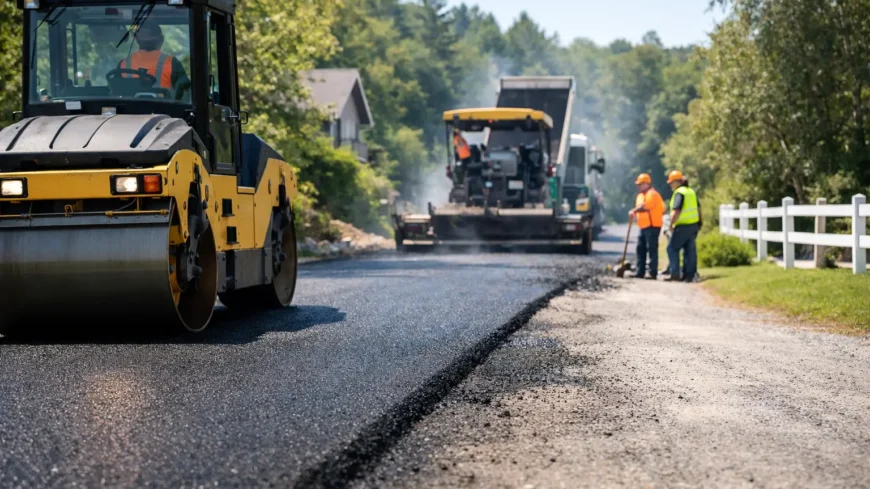
If your private road is starting to break up, hold water, or throw loose stone into verges and parked vehicles, waiting rarely saves money. A proper private road resurfacing guide starts with one hard truth: small defects become structural problems faster than most owners expect, especially on roads carrying regular cars, delivery vans, farm traffic or commercial vehicles.
Private roads sit in an awkward position. They are often heavily used, but maintenance decisions are left to homeowners, landowners, businesses, factors or site managers who do not always have a clear plan. That is why resurfacing needs to be approached as a practical investment, not a cosmetic patch-up. Done well, it improves safety, drainage, appearance and long-term running costs. Done badly, it simply delays the same problem by a season or two.
What a private road resurfacing guide should help you decide
The first question is not always whether the road needs resurfacing. It is whether resurfacing is the right level of repair. A worn surface can look poor but still have a sound base. On the other hand, a road with widespread cracking, movement at the edges, standing water and repeated potholes may need more than a new top layer.
This matters because resurfacing only works when the structure underneath can support it. If the base has failed, laying fresh material on top may improve the look briefly, but traffic and weather will reopen the same weak areas. A dependable contractor should tell you where resurfacing is suitable and where localised reconstruction is the better option.
For private estates, shared access roads, business parks and long residential lanes, this early assessment often makes the biggest difference to the final cost.
Signs your road is ready for resurfacing
Some roads make the decision obvious. Others deteriorate gradually, and owners get used to the defects. If vehicles are slowing to avoid potholes, if surface water is sitting after light rain, or if the road edge is crumbling into soft ground, the surface is already affecting day-to-day use.
Cracking is another key warning sign. Fine surface cracks can sometimes be treated early, but wider cracking or interconnected cracking usually points to deeper stress. The same goes for rutting where wheels repeatedly track through the same line. Once the road starts deforming under traffic, patching becomes less cost-effective.
Appearance also matters more than some owners think. For commercial premises, managed developments and public-facing sites, a poor road surface suggests neglect and can create a bad first impression. More importantly, loose and uneven surfaces increase trip risks, splash problems and vehicle wear.
Choosing the right surface for a private road
A good private road resurfacing guide should be honest here – there is no single best material for every site. The right choice depends on traffic levels, the condition of the base, drainage, appearance, and budget.
Tarmac and asphalt
For many private roads, tarmac or asphalt is the most practical choice. It provides a clean, durable finish, handles regular traffic well, and can be laid efficiently to reduce disruption. It is particularly suitable where a smooth, hard-wearing surface is needed for residential access roads, business premises, car parks and mixed-use sites.
The quality of the result depends heavily on preparation, levels and compaction. A well-installed tarmac surface should shed water properly, resist fretting, and stand up to routine use for years. If heavy vehicles use the road regularly, the specification may need to be adjusted to suit that loading.
Tar and chip
Tar and chip can be a sensible option for longer rural roads, private lanes and estates where a more traditional appearance is preferred and budget control is a major factor. It can offer good value over larger areas and works well in the right setting.
That said, it is not ideal for every location. It can produce a less uniform finish than tarmac, and it may not suit sites where a cleaner, more formal look is expected. It also needs to be applied under the right conditions and on a properly prepared surface to perform well.
Drainage is often the real issue
If water stays on the road, resurfacing alone will not solve the underlying problem. Poor falls, blocked channels, failed edges and soft verges all contribute to standing water, and standing water is one of the quickest ways to shorten the life of a road surface.
This is where experience matters. A contractor should assess how water currently moves across the site and where it is getting trapped. Sometimes the answer is correcting levels during resurfacing. In other cases, the road may need edge repairs, drainage channels, gully work or localised excavation before the new surface is laid.
In Scotland, where wet weather is part of normal working life, drainage cannot be treated as an afterthought. It is part of whether the road lasts.
Resurfacing versus patching
There is always a point where ongoing patch repairs stop being good value. A few isolated potholes can be repaired effectively. But when defects are spread across the road, patching starts to create an uneven surface with multiple joints and weak points.
A resurfaced road is not just about appearance. It gives you continuity across the running surface, improves ride quality, and removes many of the joins where water can get in. For commercial owners and facilities managers, it can also reduce repeated call-outs and complaints.
The trade-off is upfront cost. Full resurfacing is a bigger spend than local patching, so the right decision often depends on how long you intend to keep the road in service without major intervention. If you are patching the same areas repeatedly, resurfacing is usually the more sensible route.
What affects the cost of resurfacing a private road
Road owners often ask for a rate per square metre, but that only tells part of the story. Two roads of the same size can vary significantly in price depending on access, existing condition and the amount of preparation required.
The biggest cost factors are usually the condition of the sub-base, the depth and type of surface needed, drainage corrections, edging works, and how easy it is to get plant and materials to site. A narrow road with awkward access and failing edges can be more demanding than a straightforward open area.
Traffic type matters too. A private road serving a few homes will not usually need the same specification as a roadway taking delivery vehicles, bin lorries or regular commercial traffic. Paying for the correct build-up at the start is cheaper than under-specifying and having to revisit the job early.
How the work should be planned
Good resurfacing work is not only about laying material. It is about planning the job so the road functions properly afterwards and disruption stays manageable.
Site survey and specification
The road should be surveyed properly. That means looking at defects, measuring levels, checking drainage, identifying weak areas and understanding traffic use. From there, the contractor can recommend whether the road needs surface dressing, overlay, planing and resurfacing, or sections of reconstruction.
Preparation
Preparation is where a lot of poor jobs fail. Loose material, unstable edges, potholes, poor joints and surface contamination need to be dealt with before resurfacing starts. If this stage is rushed, the finished surface may look acceptable on day one and disappoint soon after.
Laying and finishing
Once the surface is laid, compaction, levels and tie-ins all matter. The road should finish evenly, with proper falls and tidy transitions to gates, kerbs, channels or adjoining surfaces. Where line marking is needed, that should be planned as part of the works rather than treated as an afterthought.
Choosing a contractor without getting caught out
Price matters, but so does accountability. Private road resurfacing is not a product you can inspect fully before it is installed. You are paying for workmanship, preparation and judgement as much as material.
Look for a contractor who is clear about what is included, willing to explain the specification, and realistic about what the existing road condition will allow. If a quote is vague on preparation or avoids discussing drainage, that should raise questions. The same applies if you are promised a full cure for a failing road with no mention of base repairs.
For owners and site managers, reliability is not a soft benefit. It affects programme, access, safety and whether the job needs to be redone. A family-run contractor with proper surfacing experience can often offer the balance people want – professional capability, straightforward advice and the confidence that someone will stand behind the work.
When timing matters most
Resurfacing is best arranged before the road reaches the point of frequent failure. Once potholes, edge collapse and water ingress become widespread, the scope often grows. Acting earlier gives you more repair options and better cost control.
It also helps to plan around site use. Residential roads may need phased access arrangements. Commercial sites may need weekend or off-peak working. Schools, depots and shared developments all have their own access pressures, so the job should be organised around real use, not just contractor convenience.
A road surface does not have to be completely broken to justify resurfacing. It only has to be costing you more in risk, maintenance or disruption than a proper repair would. If you approach the decision with a clear assessment, the right specification and a contractor who takes responsibility from start to finish, the result is straightforward: a safer, stronger road that does its job properly every day.